

Linksys LGS310MPC TAA Compliant 8-Port Managed Gigabit PoE+ Switch 110W Budget Plus 2 x 1G SFP Uplinks 10 Ports Total Static Routing VLAN QoS Fanless 5-Year Warranty
Linksys LGS310MPC TAA Compliant 8-Port Managed Gigabit PoE+ Switch 110W Budget Plus 2 x 1G SFP Uplinks 10 Ports Total Static Routing VLAN QoS Fanless 5-Year Warranty
SKU: LGS310MPC
UPC: 745883810154
Condition: Brand New, Factory Sealed
Authentic: Guaranteed 100% Genuine Linksys Product
Fulfillment: Ships Same Business Day (Cutoff 3PM ET)
Warehouse: Ships from U.S. Warehouse
Shipping: Free UPS Ground Shipping
Returns: 30-Day Hassle-Free Returns
Support: U.S. Based Pre & Post-Sales Support
Sales Tax: Charged on Pennsylvania orders only — No tax for most out-of-state customers
Agotado
No se pudo cargar la disponibilidad de retiro
- Genuine OEM Products
- Hassle-Free Returns
- Free U.S. Based Product Support
Key Features
- Ten physical ports: 8 copper Gigabit RJ45 on ports 1 to 8, plus 2 dedicated 1G SFP uplinks on ports 9 and 10. The uplinks are additional to the eight, not carved out of them.
- All eight copper ports are PoE+, not a subset of them. The standard is 802.3at, with 802.3af backward compatibility.
- 110 W total PoE budget, which is 13.75 W averaged across eight ports. Plan for three or four devices at full PoE+ draw, or eight low-power ones.
- TAA compliant, which Linksys carries in the product's own name. For federal, GSA, state and public-sector buyers that is the strongest thing on this page.
- Fully managed, not smart or web-managed-lite: web UI over HTTP and HTTPS, plus Telnet, SSH, a documented CLI and SNMP v1, v2c and v3.
- IPv4 and IPv6 static routing, capped at 63 IPv4 and 21 IPv6 route entries. No dynamic routing protocol is supported.
- Fanless, so it runs silent. That suits an office, a counter, a classroom or a reception cupboard, which is where a switch this size usually lives.
- 20 Gbps switching capacity and 14.88 Mpps forwarding, which is wire speed on all ten ports at once.
- 256 active VLANs from a 4,096 range, port-based and 802.1Q, with automatic voice VLAN assignment by OUI and guest VLAN support.
- 802.1X RADIUS authentication, DHCP snooping, IP-MAC binding, port security, DoS attack prevention, port isolation, plus IPv4 and IPv6 ACLs.
- Powered by an external 120 W adapter rather than an internal supply, which is why it weighs 636 g and needs no fan.
- Five-year Linksys warranty in the United States.
Key Specifications
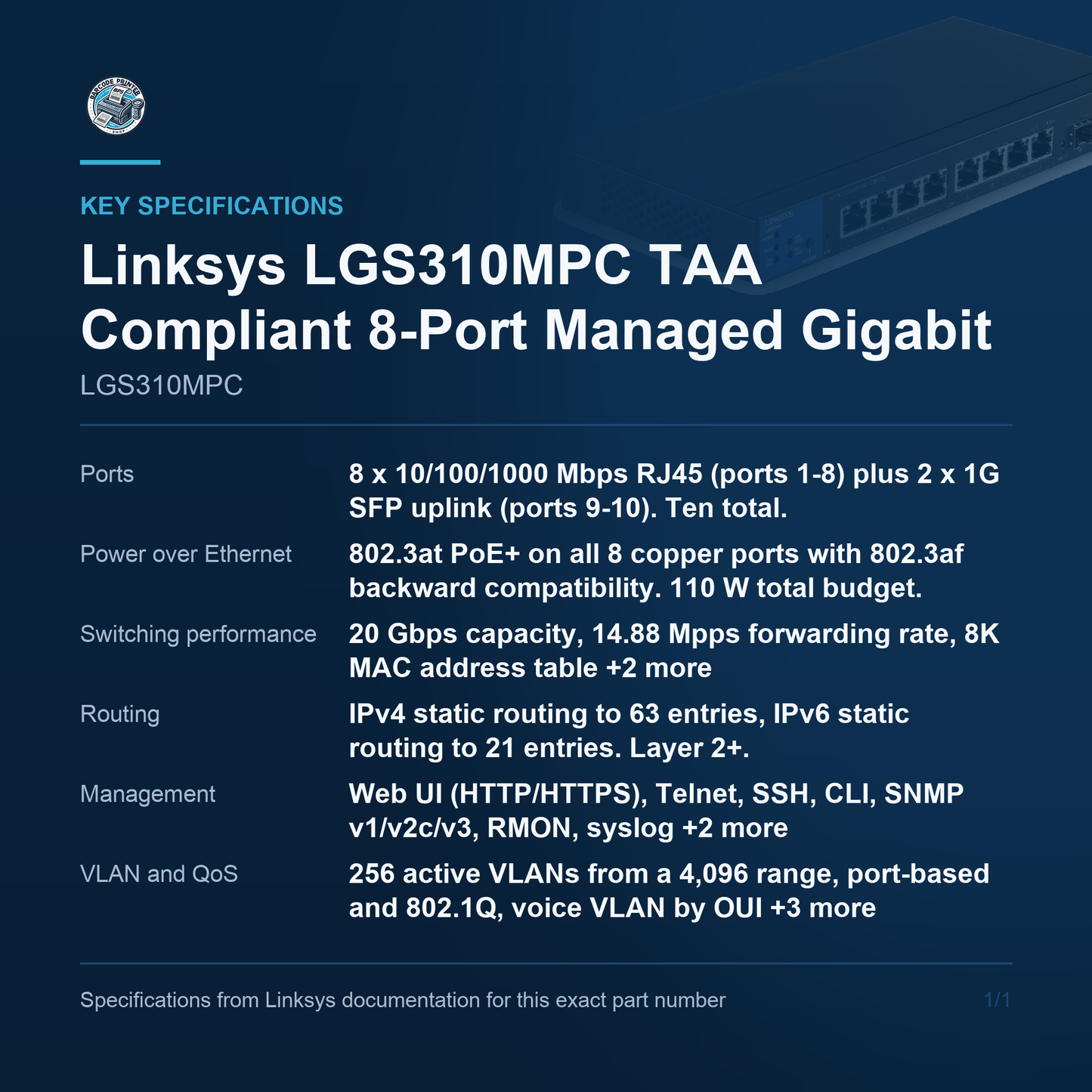
- Ports: 8 x 10/100/1000 Mbps RJ45 (ports 1-8) plus 2 x 1G SFP uplink (ports 9-10). Ten total. SFP transceivers are not included
- Power over Ethernet: 802.3at PoE+ on all 8 copper ports with 802.3af backward compatibility. 110 W total budget. No 802.3bt
- Switching performance: 20 Gbps capacity, 14.88 Mpps forwarding rate, 8K MAC address table, 10 Kbyte jumbo frames, 256 MB DRAM
- Routing: IPv4 static routing to 63 entries, IPv6 static routing to 21 entries. Layer 2+. No RIP, OSPF or BGP
- Management: Web UI (HTTP/HTTPS), Telnet, SSH, CLI, SNMP v1/v2c/v3, RMON, syslog, port mirroring to 3 ports, dual firmware images. No cloud management
- VLAN and QoS: 256 active VLANs from a 4,096 range, port-based and 802.1Q, voice VLAN by OUI, guest VLAN; 8 hardware queues, strict and weighted round robin, 802.1p and DSCP class of service
- Security: 802.1X RADIUS, DHCP snooping, IP-MAC binding, port security to 256 locked MAC addresses per port, DoS attack prevention, port isolation, IPv4 and IPv6 ACLs
- Resilience: 802.1d STP, 802.1w RSTP, 802.1s MSTP with 16 instances, 802.3ad LACP to 8 groups of 8 ports, loopback detection, head-of-line blocking prevention
- Multicast: IGMP v1, v2 and v3 snooping with 256 multicast groups; MLD v1 snooping with fast leave, querier and report suppression
- Power: External adapter, 120 W AC/DC, single output 54 V DC at 2.22 A. Input 100-240 V, 50-60 Hz, 2.2 A. Maximum consumption 133.77 W with PoE+. Fanless
- Physical: 240 x 105 x 27 mm (9.45 x 4.13 x 1.06 in), 636 g (1.40 lb). Desktop or wall-mount. Not a rack product and no rack ears exist for it
- Warranty: 5 years in the United States (2 years in Australia and New Zealand)
Ten ports, not eight
The port count is the specification that decides whether a switch fits, and on this model it is commonly stated ambiguously. The answer is ten physical ports. Linksys prints the numbering: copper Gigabit RJ45 on ports 1 to 8, and 1G SFP on ports 9 and 10. The SFP pair is dedicated uplink, additional to the eight copper ports rather than shared with any of them, so nothing is lost by using them. The switching capacity confirms it arithmetically at 20 Gbps, which is ten ports at 1 Gbps in both directions. Note that these are 1G SFP cages, not SFP+, so there is no 10G uplink here, and no transceivers and no Ethernet cable are in the box.
The PoE budget
All eight copper ports are PoE+ rather than a subset of them, and the total budget shared across them is 110 W. That arithmetic is worth doing before the order rather than after: 110 W over eight ports averages 13.75 W, so this switch will run three or four devices at full PoE+ draw, or all eight at low-power 802.3af class, but not eight high-draw devices at once. A quotation promising all eight ports at full PoE+ draw at once describes a switch that does not exist. The standard fitted is 802.3at, which is PoE+, with backward compatibility to 802.3af, which is plain PoE. 802.3bt is not supported, so high-power pan-tilt-zoom cameras and multi-radio access points need a different switch. Linksys publishes no per-port maximum wattage and none is invented here.
Static routing, confirmed
Static routing on an eight-port switch sounds like marketing and in this case it is not. Linksys documents it three ways: the hardware table gives L3 static routing at 63 maximum IPv4 entries and 21 maximum IPv6 entries, the feature list names static routing and IPv6 support, and the user guide describes configuring destination, subnet mask and gateway by hand. So this is properly a Layer 2+ switch, capable of forwarding between subnets without a router in the path. What it does not do is dynamic routing. No RIP, OSPF or BGP appears anywhere in Linksys's documentation, so it will not learn a route or join a routing domain, and 63 IPv4 entries is the ceiling.
Managed, not smart
This is a fully managed switch rather than a smart or web-managed-lite one, and the difference shows up the first time somebody needs to script a change or point a monitoring system at it. The web UI over HTTP and HTTPS is the primary interface, but Telnet, SSH and a command line documented in a Linksys CLI manual of its own are all present, together with SNMP v1, v2c and v3, RMON, syslog to a remote host, port mirroring to as many as three ports, and dual firmware images so an upgrade can be rolled back. What does not exist is cloud management. There is no Linksys portal, no remote dashboard and no phone app: this switch is administered on the local network.
Fanless and silent
Linksys prints Fans: NA for this model, and on a switch that lives where people work that is a feature rather than a footnote. There is no fan noise, no dust intake and no fan to fail, which is the most common mechanical failure on small switches. The trade for that silence is size and placement: this is a compact desktop unit at 240 x 105 x 27 mm and 636 g, about half a rack width, and it is not a rack product. No rack ears exist for it and no Linksys document describes rack mounting. What Linksys does supply is a wall-mount kit of two screws and two drywall anchors, so it will sit on a shelf, on a desk or on a wall. No acoustic figure is published, only the absence of fans.
External power supply
This switch is powered by an external brick, not an internal PSU, and it is worth saying because 110 W PoE switches usually are internally powered and installers plan the cabinet on that assumption. The supplied adapter is a 120 W AC/DC unit with a single 54 V DC output at 2.22 A, running from 100 to 240 V at 50 to 60 Hz. Two figures that look contradictory are not: 133.77 W is the maximum draw at the wall with PoE+ running, including conversion loss in the adapter, while roughly 120 W reaches the switch and 110 W of that is the PoE budget. Practically, allow room for the brick and its lead, and remember it is a part that can be lost or damaged separately from the switch.
TAA and warranty
Two facts go missing from most listings of this switch. The first is TAA compliance, which Linksys carries in the product's own name and in its feature list. For a US federal buyer, a GSA schedule purchase, a state or municipal contract, or any prime contractor buying under a flow-down clause, that is not a nice-to-have but the gate a product has to pass to be quotable at all. The second is the warranty: Linksys publishes five years, with a named exception list covering Australia and New Zealand at two years. The United States is not on that list, so a US buyer gets the full five-year limited hardware term, which outlasts most competing switch warranties.
Firmware and lifecycle
The LGS310MPC does not appear on Linksys's product end-of-life page and there is no discontinuation notice or named successor in any Linksys document, so it is treated here as an active product. One maturity signal is worth knowing before anyone standardises a large estate on it: the latest published firmware is 1.01.02.02, dated June 2022, with nothing released since. That is a mature and stable product rather than a moving target, which suits a validated install, but it also means new features are unlikely to arrive. Those release notes cover a sibling as well, the LGS310C, which is the same switch without PoE and is the part to price where the endpoints have their own power.
Barcode Printer Shop supplies Linksys network hardware to US businesses, with port counts, power budgets and warranty terms stated on the page rather than left in a datasheet. Contact us to learn more or secure this solution for your business today.