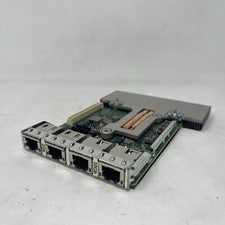


Dell Broadcom 57416 and 5720 Quad Port rNDC Network Daughter Card 2 x 10GBASE-T Plus 2 x 1GBASE-T RJ45 1224N
Dell Broadcom 57416 and 5720 Quad Port rNDC Network Daughter Card 2 x 10GBASE-T Plus 2 x 1GBASE-T RJ45 1224N
SKU: 1224N
UPC: 754063783942
Condition: Brand New, Factory Sealed
Authentic: Guaranteed 100% Genuine Dell Product
Fulfillment: Ships Same Business Day (Cutoff 3PM ET)
Warehouse: Ships from U.S. Warehouse
Shipping: Free UPS Ground Shipping
Returns: 30-Day Hassle-Free Returns
Support: U.S. Based Pre & Post-Sales Support
Sales Tax: Charged on Pennsylvania orders only — No tax for most out-of-state customers
Out of stock
Couldn't load pickup availability
- Genuine OEM Products
- Hassle-Free Returns
- Free U.S. Based Product Support
Key Features
- This is a QUAD-port card, not a dual-port card: two 10GBASE-T ports from a Broadcom BCM57416 plus two 1GBASE-T ports from a Broadcom BCM5720.
- All four ports are copper RJ45. Dell prints RJ45 for 10Gbps and 1Gbps against this card.
- It is a rack Network Daughter Card. It fits the PowerEdge rNDC connector and does not occupy a standard PCIe slot.
- Host interface is PCI-E Gen 3 x8.
- NPAR partitioning: up to eight physical functions per port, or up to 16 per silicon.
- SR-IOV: 128 virtual functions per device for guest operating systems.
- RoCE v1 and v2 RDMA support on Windows, Linux and VMware.
- iSCSI boot is supported.
- TCP checksum offload on both the transmit and the receive side.
- FCoE is NOT claimed for this card. It is absent from Dell's own Broadcom guide.
- Dell order code 540-BBUK, described by Dell as Broadcom 57416 10G BT 2P + 5720 1G BT 2P network daughter card rNDC.
- No platform compatibility list is published here, because Dell's own guide returned two different lists on two reads.
Key Specifications
- Part class: Rack Network Daughter Card (rNDC) for PowerEdge servers
- Silicon: Broadcom BCM57416 (10GbE) and Broadcom BCM5720 (1GbE) on one card
- Port inventory: Port 1 and Port 2: 10GBASE-T RJ45. Port 3 and Port 4: 1GBASE-T RJ45
- Media: Copper RJ45 on all four ports. This is not an SFP+ card
- Host interface: PCI-E Gen 3 x8, through the PowerEdge rNDC connector
- NPAR: Up to eight physical functions per port, up to 16 per silicon
- SR-IOV: 128 virtual functions per device for guest operating systems
- RDMA: RoCE v1 and v2 on Windows, Linux and VMware
- Boot: iSCSI boot supported
- Offload: TCP checksum offload, transmit and receive
- FCoE: Not claimed. NONE PRESENT in Dell's Broadcom NetXtreme guide
- Dell order code: 540-BBUK
Quad port, not dual
This card carries four network ports, not two, and our live listing has been underselling it. Two of them are 10GBASE-T from a Broadcom BCM57416 and two are 1GBASE-T from a Broadcom BCM5720, on one board, in one rNDC position. Dell's own order code description for 540-BBUK spells it out: Broadcom 57416 10G BT 2P plus 5720 1G BT 2P. In a server build that combination is genuinely useful rather than decorative, because the two gigabit ports give a separate path for management, backup or a cluster heartbeat without spending a PCIe slot on a second card. Anyone comparing this against a dual-port card is comparing the wrong thing.
Copper 10GBASE-T, not SFP+
All four ports are copper RJ45. Dell's own Broadcom guide prints Dual Port 10GBase-T Ethernet for the 57416 silicon and RJ45 for 10Gbps and 1Gbps for the card, so the 10 GbE side terminates in a standard eight-pin socket and takes a copper patch lead rather than a transceiver. That is the fork that decides whether this part fits a rack: if the top-of-rack switch expects SFP+ optics or twinax, this is the wrong card, and the Broadcom 57412 is the SFP+ part rather than this one. If the switch has 10GBASE-T ports, this card connects over structured copper with no optics budget at all and no transceiver to source.
The rNDC connector
This is a rack Network Daughter Card, and the form factor is worth understanding before ordering because it is not a PCIe slot card. It mounts on the PowerEdge rNDC connector, a dedicated position on the system board reserved for the network card, and its host interface is PCI-E Gen 3 x8 delivered through that connector. Two consequences follow. It cannot be installed in a server that has no rNDC position, whatever its expansion slots look like. In a server that does have one, the card uses none of the expansion slots, so all four ports arrive without costing a riser slot that a controller or a GPU might need.
NPAR and SR-IOV
The virtualisation feature set is the reason to choose this card over a plain gigabit rNDC. Dell's Broadcom guide states NPAR support for up to eight physical functions per port, or up to 16 per silicon, which lets one physical port be presented to the operating system as several independent adapters with their own bandwidth allocations. SR-IOV support is 128 virtual functions per device for guest operating systems, so virtual machines can be given direct hardware paths to the network rather than passing through the hypervisor's software switch. On a consolidated host running many guests that is the difference between a card that scales and one that becomes the bottleneck.
RDMA and iSCSI boot
Dell's guide states that the BCM5741X silicon supports RoCE v1 and v2 for Windows, Linux and VMware, so remote direct memory access is available on all three major platforms rather than on one of them. RDMA matters where storage traffic shares the network: it lets one host write into another's memory without going through the CPU on either end, which is what makes 10 GbE storage networking practical rather than merely fast. iSCSI boot is supported, so a diskless server can start from a SAN target over these ports. TCP checksum offload runs on transmit and receive. What is not supported, or at least not printed, is FCoE.
Compatibility not published
No platform list is published on this page and the reason is worth stating rather than hiding. Dell's own Broadcom guide was read twice with independently worded prompts and returned two materially different model lists: one partial, one a full table, and the document itself labels 14th generation machines as 13G systems. A parts vendor separately publishes a five-model list for this exact part number, and a second vendor page publishes none at all. None of that is firm enough to sell fitment on. Check the rNDC position and the supported-card list for the specific PowerEdge generation, or send us the service tag and we will check it against Dell.
Where it fits
Buy this card for a PowerEdge with an rNDC position that needs copper 10 GbE now and gigabit management ports alongside it: a virtualisation host, an iSCSI or NFS storage client, a backup target, or any server whose expansion slots are already committed. The NPAR and SR-IOV figures make it a hypervisor card rather than simply a fast one. Do not buy it for an SFP+ or twinax rack, for a server with no rNDC connector, or for a fabric that needs FCoE, since Dell's guide does not list FCoE against this silicon and this listing will not claim it.
Barcode Printer Shop supplies Dell server parts by exact part number, with fitment stated only where Dell itself states it. Contact us to learn more or secure this solution for your business today.