

Honeywell Xenon XP 1952h Cordless 1D/2D Healthcare Barcode Scanner Bluetooth High Density White Disinfectant-Ready Scanner Only 1952HHD-5-N
Honeywell Xenon XP 1952h Cordless 1D/2D Healthcare Barcode Scanner Bluetooth High Density White Disinfectant-Ready Scanner Only 1952HHD-5-N
SKU: 1952HHD-5-N
UPC: 0993299142455
Condition: Brand New, Factory Sealed
Authentic: Guaranteed 100% Genuine Honeywell Product
Fulfillment: Ships Same Business Day (Cutoff 3PM ET)
Warehouse: Ships from U.S. Warehouse
Shipping: Free UPS Ground Shipping
Returns: 30-Day Hassle-Free Returns
Support: U.S. Based Pre & Post-Sales Support
Sales Tax: Charged on Pennsylvania orders only — No tax for most out-of-state customers
Low stock: 5 left
Couldn't load pickup availability
- Genuine OEM Products
- Hassle-Free Returns
- Free U.S. Based Product Support
End of life. Honeywell discontinued the Xenon XP 1952h in July 2024, with service and support running to December 2029. Honeywell designates the Xenon 1960h as the replacement, but that is a corded scanner and is not a like-for-like swap for a cordless one. For a cordless healthcare replacement our recommendation, not Honeywell's designation, is the Xenon Ultra 1962h, which we stock in several configurations. Remaining 1952h units suit fleet matching and sites already running Xenon XP bases.
Key Features
- Bluetooth 4.2 with adaptive frequency hopping, Class 1 at 100 m line of sight by default.
- Li-ion pack rated 2,400 mAh minimum, around 72,000 scans and 20 hours of operation.
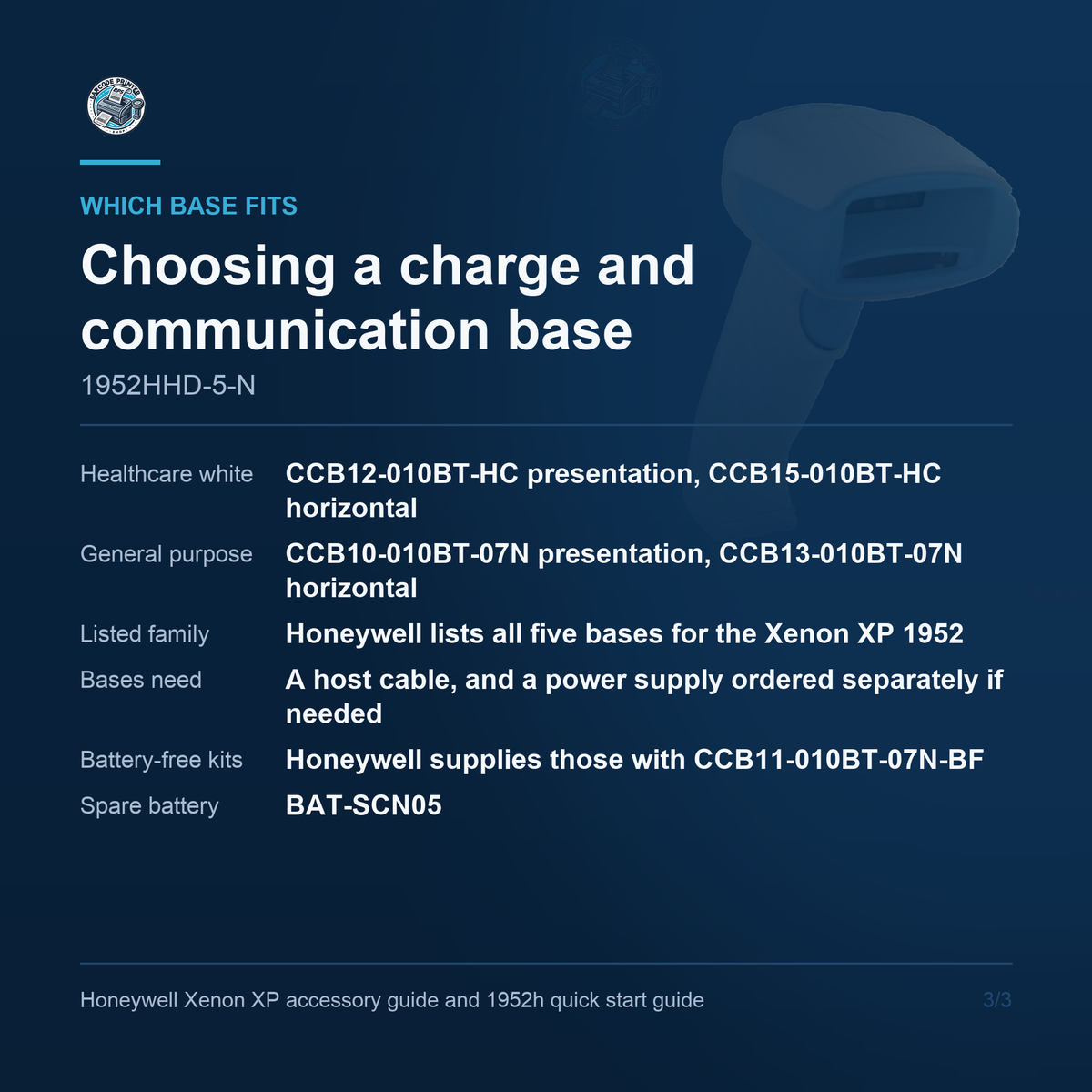
- Scanner only on this part number: no charge base, no cable and no power supply.
- White disinfectant-ready housing built to take repeated cleaning with harsh chemicals.
- Reads 1D, PDF417, 2D, postal, Digimarc, DotCode and OCR symbols from one area imager.
- High density focus option reads dense codes from closer in than the standard-range build.
- Keeps up with a fast operator at up to 400 cm per second on a 13 mil UPC barcode.
- Decodes at 15 percent minimum reflectance difference, so faded and worn labels still read.
- Works from complete darkness to 100,000 lux, which covers a sunlit window bay.
- Full 360 degrees of roll tolerance, so labels need no lining up before scanning.
- Survives 50 drops to concrete from 1.8 m and 2,000 tumbles from 0.5 m, sealed to IP52.
- Honeywell Scanner Management Utility configures and audits deployed units remotely.
Key Specifications
- Configuration: Cordless scanner only, no base or cable
- Radio: Bluetooth 4.2, Class 1 at 100 m, programmable to Class 2 at 10 m
- Battery: Li-ion 2,400 mAh minimum, 72,000 scans, 4.5 hour charge
- Imager: Area imager, 1280 x 800 pixel array
- Focus option: HD, high density
- Motion tolerance: Up to 400 cm/s (157 in/s) on 13 mil UPC
- Durability: 50 drops to concrete from 1.8 m, 2,000 tumbles from 0.5 m, IP52
- Environment: 0 to 50 C operating, 0 to 95 percent humidity non-condensing
- Host interfaces: USB, keyboard wedge, RS-232 and RS-485 (IBM 46xx)
- Scan angles: Horizontal 48 deg, vertical 30 deg
- Dimensions: 104.1 x 71.1 x 160 mm, 212.6 g (7.5 oz)
- Warranty: 3 years on the scanner, 1 year on the battery
Which configuration this is
This part number is the cordless 1952h scanner on its own. The carton holds the white disinfectant-ready handset with its lithium-ion battery fitted, and nothing else: no charge and communication base, no host cable and no power supply. That makes it the right part for a hospital already running Xenon XP 1952 bases that needs additional or replacement handsets, and the wrong part for a first deployment. A cordless scanner with no base has nowhere to charge and no path to the host, because the interface is decided by the cable plugged into the base, not by the scanner.
What high density means
The HD in this part number is the focus option, not a better sensor. Both the standard-range and high-density builds use the same 1280 by 800 area imager; what differs is the optics. The high density configuration pulls its working range in closer and resolves finer elements, which is why it is the right choice for pharmacy labels, laboratory specimen tubes, wristbands, unit-dose packaging and the small dense 2D codes that carry unique device identifiers. Honeywell's own figures for this generation show a 5 mil Code 39 read from 16 mm on HD against 28 mm on standard range, and a 10 mil Data Matrix from 11 mm rather than 27 mm. The trade is at the far end: a 20 mil code reaches 620 mm on HD against 829 mm on standard range.
Disinfectant-ready housing
Disinfectant-ready is a material specification, not a marketing adjective. Hospital cleaning protocols call for wiping devices down repeatedly with bleach, hydrogen peroxide, quaternary ammonium and alcohol-based agents, and ordinary ABS housings craze, yellow and eventually crack under that regime. Honeywell moulds these scanners in a plastic engineered to resist it, and publishes a cleaning guide naming the agents it has tested. That guide is the document to work from when writing a local cleaning protocol, because neither the datasheet nor the product page names a chemical. The housing is white so that soiling is visible rather than hidden, which is itself part of the infection-control rationale.
Radio and battery
The radio is Bluetooth 4.2 with adaptive frequency hopping, which is what keeps it civil in a building saturated with Wi-Fi and medical telemetry. Class 1 gives 100 m of line of sight range as shipped, and it is programmable down to Class 2 at 10 m where a tighter cell is wanted. The battery is a lithium-ion pack rated at 2,400 mAh minimum, which Honeywell puts at roughly 72,000 scans and about 20 hours of operation, recharging in around four and a half hours. The spare pack is BAT-SCN05. Note that the scanner carries a three-year warranty and the battery only one year, which is normal for a consumable cell but worth budgeting for.
Optics and build
The 1952h reads at horizontal 48 degrees and vertical 30 degrees, which is wider than the corded 1950h in the same generation at 42 and 27 degrees. It is the same imager and the same 400 cm per second motion tolerance, but the two are not interchangeable on paper and specifications should not be cross-quoted between them. Physically the cordless handset is the same 104.1 by 71.1 by 160 mm as the corded one but heavier at 212.6 g against 147.4 g, the difference being the battery. Both survive 50 drops to concrete from 1.8 m and 2,000 tumbles, and both are sealed to IP52.
Deployment and interfaces
Honeywell's Scanner Management Utility handles configuration, firmware and audit across a deployed fleet, so settings can be pushed rather than walked round on a barcode sheet. The scanner presents USB, keyboard wedge, RS-232 and RS-485 for IBM 46xx terminals, which covers both a modern browser-based electronic record system and the older terminal estate that hospitals frequently still run alongside it. Good-decode LEDs, rear-view LEDs, an adjustable beeper and a vibration option cover the feedback problem on a ward at night, where an audible beep is unwelcome and the operator still needs to know the scan landed.
What is included
The white disinfectant-ready 1952h handset with its lithium-ion battery fitted, and a vibration motor. Nothing else. The presentation charge base (CCB10 black, CCB12 healthcare white), the horizontal desktop and wall-mount bases (CCB13, CCB15), the host cable that decides the interface, and the 46-00525 power supply are all separate orders. If you want the healthcare-white base with healthcare software rather than the black general-purpose one, the part is CCB12-010BT-HC. Ask us and we will quote the base and cable that match your host.
For pharmacy, laboratory, ward and bedside scanning where the device is wiped down many times a day, the Honeywell Xenon XP 1952h 1952HHD-5-N remains a capable choice while stock lasts. Contact us to learn more or secure this solution for your business today.