

Honeywell Granit XP 1991iSR Cordless Bluetooth 2D Area Imager Standard Range Scanner Only No Base No Cable TAA Compliant 1991ISR-3-N
Honeywell Granit XP 1991iSR Cordless Bluetooth 2D Area Imager Standard Range Scanner Only No Base No Cable TAA Compliant 1991ISR-3-N
SKU: 1991ISR-3-N
UPC: 754063784116
Condition: Brand New, Factory Sealed
Authentic: Guaranteed 100% Genuine Honeywell Product
Fulfillment: Ships Same Business Day (Cutoff 3PM ET)
Warehouse: Ships from U.S. Warehouse
Shipping: Free UPS Ground Shipping
Returns: 30-Day Hassle-Free Returns
Support: U.S. Based Pre & Post-Sales Support
Sales Tax: Charged on Pennsylvania orders only — No tax for most out-of-state customers
Low stock: 1 left
Couldn't load pickup availability
- Genuine OEM Products
- Hassle-Free Returns
- Free U.S. Based Product Support
Key Features
- In the box: Red 1991iSR-3 scanner and the BAT-SCN05 Smart Battery. No base, no cable, no power supply.
- Granit XP generation: a 1280 x 800 pixel area imager that decodes at 20% minimum reflectance difference, against 30% and 40% on the older Granit 1981i.
- Motion tolerance up to 4500 mm per second, which is 177 in per second, so codes can be read on the move.
- Cordless Bluetooth v4.2 Class 1 with 100 m or 330 ft of line-of-sight range.
- Up to 50,000 scans and 14 hours of operation per charge on the BAT-SCN05 Smart Battery.
- Standard range optics: reads a 20 mil Code 39 out to 33.0 in and a 13 mil UPC out to 19.8 in.
- Reads 1D, PDF, 2D, postal, Digimarc, DotCode and OCR symbologies.
- Rated to MIL-STD-810G with 3 m drops, plus 50 drops at 2 m from minus 30 C to 50 C, and 7,000 tumbles at 1 m.
- Sealed to IP67 and IP65, so it survives immersion as well as dust and jets.
- Vibrator feedback for good reads where a beeper cannot be heard.
- Three-year factory warranty on the scanner, one year on the battery.
- TAA-compliant build, assembled in Mexico, which is what federal, GSA, state and other public-sector contracts require.
Key Specifications
- In the box: Red 1991iSR-3 scanner and the BAT-SCN05 Smart Battery. No base, no cable, no power supply.
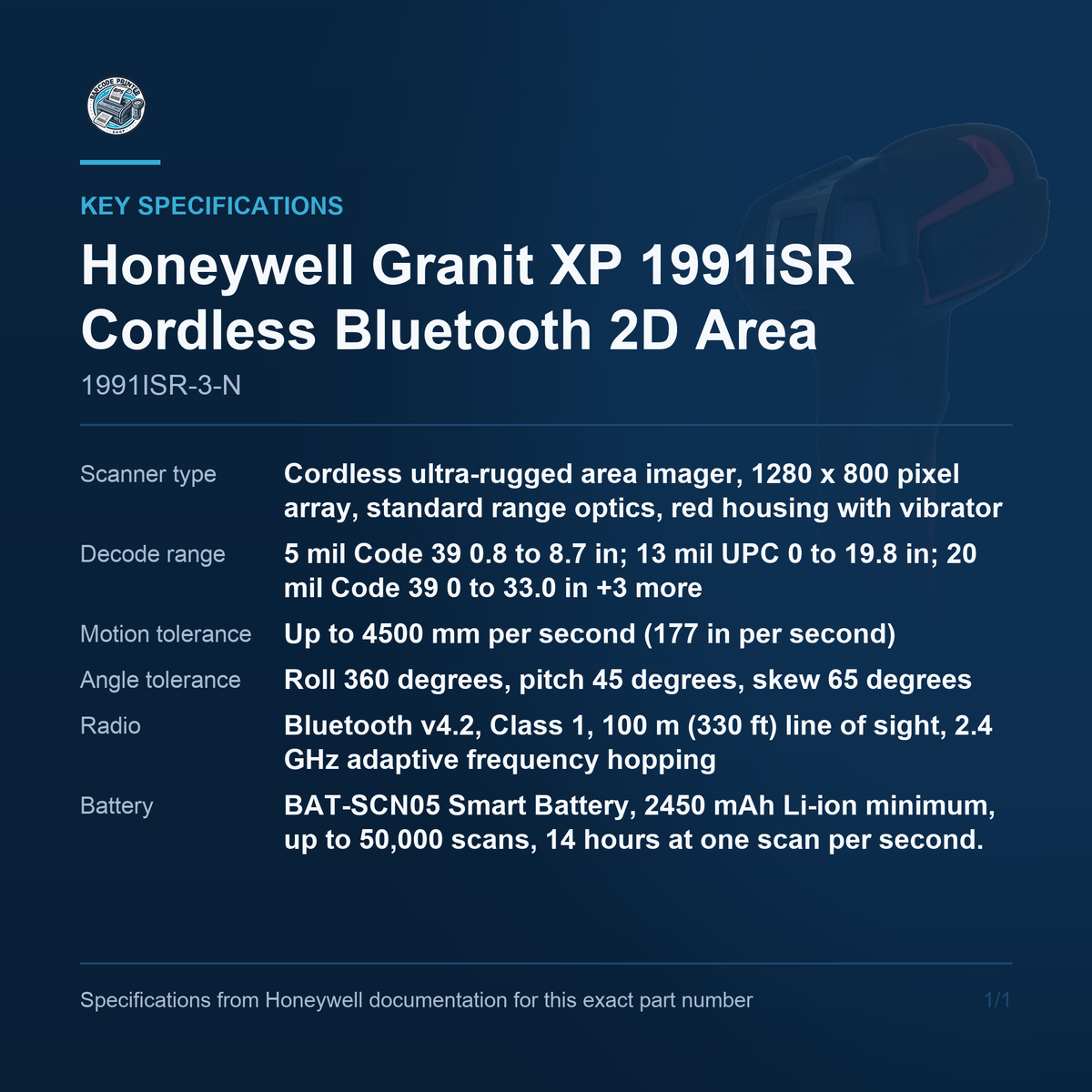
- Scanner type: Cordless ultra-rugged area imager, 1280 x 800 pixel array, standard range optics, red housing with vibrator
- Decode range: 5 mil Code 39 0.8 to 8.7 in; 13 mil UPC 0 to 19.8 in; 20 mil Code 39 0 to 33.0 in; 6.7 mil PDF417 0.8 to 8.2 in; 10 mil Data Matrix 1.2 to 8.6 in; 20 mil QR 1.3 to 18.7 in. Minimum resolution 3 mil on Code 39, 6 mil on Data Matrix
- Motion tolerance: Up to 4500 mm per second (177 in per second)
- Angle tolerance: Roll 360 degrees, pitch 45 degrees, skew 65 degrees
- Radio: Bluetooth v4.2, Class 1, 100 m (330 ft) line of sight, 2.4 GHz adaptive frequency hopping
- Battery: BAT-SCN05 Smart Battery, 2450 mAh Li-ion minimum, up to 50,000 scans, 14 hours at one scan per second. Honeywell publishes no charge time
- Durability: 50 drops at 2 m from minus 30 C to 50 C; 20 drops at 2.4 m; 3 m to MIL-STD-810G; 7,000 tumbles at 1 m; IP67 and IP65
- Host interfaces: USB, keyboard wedge and RS-232 TTL, all presented by the charge and communication base
- Dimensions and weight: Scanner 192 x 76 x 100 mm (7.6 x 3.0 x 3.9 in), 405 g (14.3 oz)
- Warranty: Three-year factory warranty; battery warranty one year
- Compliance: TAA compliant, assembled in Mexico
Kit contents
This part number is the scanner and the battery, and nothing else. There is no charge and communication base, no cable and no power supply in the carton, and on a cordless scanner that is a bigger gap than it is on a corded one. The 1991iSR reaches a host through its base, and the base is what presents USB, keyboard wedge and RS-232 TTL, so as delivered this scanner has no wired path to a till or a PC and no way to recharge either. A CCB22-100BT-03N-N charge and communication base, or a COB22 charge-only base, has to be ordered alongside it every time. Order this part to add a handset to an existing base or to replace a failed unit. It is the wrong part number for a first deployment, and our previous title gave no warning of that.
Standard range optics
SR means standard range, and on the Granit XP that is a near-field specification rather than a compromise. A 20 mil Code 39 reads from contact out to 33.0 in, a 13 mil retail UPC from contact to 19.8 in, and a 20 mil QR code from 1.3 in to 18.7 in. Dense codes come in closer: 5 mil Code 39 wants 0.8 in to 8.7 in and 10 mil Data Matrix 1.2 in to 8.6 in. Minimum resolution is 3 mil on Code 39 and 6 mil on Data Matrix. What this scanner cannot do is read a rack or rafter label at distance. Honeywell builds XR and XLR variants of the same body for that, and the older full range 1981i reaches 52 ft; none of those ranges may be assumed from this part number.
Imaging engine
The engine is an area imager with a published 1280 x 800 pixel array, and the specification worth paying for is the contrast figure: it decodes down to 20% minimum reflectance difference on 1D and 2D alike, where the previous Granit generation needed 30% on 1D and 40% on 2D. That is the concrete basis for Honeywell's claim about damaged and low-quality barcodes, and it is the reason to choose this scanner for a site where labels come back abraded, over-laminated or printed on a tired ribbon. Motion tolerance is 4500 mm per second, roll is a full 360 degrees, pitch is 45 degrees and skew is 65, so an operator sweeps the code past the window at whatever angle it arrives at.
Cordless operation
The radio is Bluetooth v4.2 Class 1, rated at 100 m or 330 ft line of sight on the 2.4 GHz band with adaptive frequency hopping. Line of sight is the qualifier that matters: steel racking and dense stock both cost range, so treat the figure as a ceiling. The BAT-SCN05 Smart Battery is a 2450 mAh minimum pack rated for up to 50,000 scans or 14 hours at one scan per second, which covers a double shift. Honeywell's 199xi user guide states the scanner stores roughly 500 UPC symbols when it is out of range, so a walk beyond coverage does not lose the work. Honeywell publishes no charge time for this scanner at all, and the older 1981i's figure belongs to a different battery and charger.
Build and sealing
Durability is where the XP generation separates itself. Honeywell rates the scanner for 50 drops at 2 m across a temperature band from minus 30 C to 50 C, 20 drops at 2.4 m, and a 3 m drop to MIL-STD-810G, with 7,000 tumbles at 1 m. Sealing is quoted as IP67 and IP65 together, which covers temporary immersion as well as dust and water jets, and the base is IP51. ESD immunity is plus or minus 20 kV air and plus or minus 8 kV contact. Operating temperature is minus 20 C to 50 C, storage minus 40 C to 70 C, humidity to 95% non-condensing. The scanner is 192 by 76 by 100 mm and weighs 405 g.
TAA compliance
The trailing -N on this part number is the TAA-compliant build assembled in Mexico, and it is a procurement fact rather than a cosmetic one. Federal agencies, GSA schedule holders, many state and local governments, and prime contractors flowing Trade Agreements Act clauses down to their suppliers are required to buy compliant hardware, and a part number without the -N does not satisfy that requirement even when it is the same scanner in the same box. Honeywell renders the compliance on this family as TAA Compliant, Assembled in Mexico. Note that this decoding is specific to the Granit range: on the Genesis XP 7680g the same trailing letter is a region code and carries no TAA meaning at all.
Lifecycle watch
Honeywell has not published an end-of-life notice for the 1991iSR. On Honeywell's own discontinued products page, checked twice, the model appears only as the replacement for older scanners and never as a discontinued item, and the live product page carries no notice. What is true is that the channel is moving: two distributors now point this part number at the Granit Ultra 2105iSR, and one of them carries what reads as a Honeywell-sourced string saying so. That is a transition running ahead of Honeywell's published list rather than an announcement, so no end-of-life date appears on this page, because none exists. It is worth knowing before standardising a large fleet on this generation.
Where it fits
Warehousing, distribution, manufacturing, cold stores and yard work, wherever the codes are read at arm's length but the scanner has to survive being dropped from a truck cab. The case for it over a general-purpose imager is the housing and the contrast: 3 m to MIL-STD-810G, IP67 and IP65, 7,000 tumbles, and decoding at 20% reflectance difference on labels that a retail scanner refuses. The case against it is range. If any part of the job is reading a rack label from the aisle, this is the wrong optics package and the XR or XLR variant is the right one. If nothing is ever dropped, a lighter scanner does the same reading for less money.
Barcode Printer Shop supplies TAA-compliant Honeywell part numbers to federal, GSA, state and public-sector buyers, with the kit contents stated plainly on the page. Contact us to learn more or secure this solution for your business today.