

Honeywell PX6ie 6-Inch Industrial Thermal Transfer Label Printer 203 dpi Ethernet Tear-Off PX6E010000000120
Honeywell PX6ie 6-Inch Industrial Thermal Transfer Label Printer 203 dpi Ethernet Tear-Off PX6E010000000120
SKU: PX6E010000000120
UPC: 6048922020427
Condition: Brand New, Factory Sealed
Authentic: Guaranteed 100% Genuine Honeywell Product
Fulfillment: Ships Same Business Day (Cutoff 3PM ET)
Warehouse: Ships from U.S. Warehouse
Shipping: Free UPS Ground Shipping
Returns: 30-Day Hassle-Free Returns
Support: U.S. Based Pre & Post-Sales Support
Sales Tax: Charged on Pennsylvania orders only — No tax for most out-of-state customers
Out of stock
Couldn't load pickup availability
- Genuine OEM Products
- Hassle-Free Returns
- Free U.S. Based Product Support
End of life. Honeywell has placed the PX6ie at end of life and names PX65A00000000200 as the successor to this exact configuration in its own channel text. Barcode Printer Shop does not currently stock a Honeywell industrial printer successor. Honeywell publishes no discontinuation date and no service-end date for the PX6ie: its product pages have been withdrawn and the model does not appear on Honeywell's discontinued-products list, so no date is stated here rather than one being estimated. Remaining PX6E010000000120 stock is sold for fleet matching, replacement units and validated workflows where requalifying a new model is not practical.
Key Features
- Media option 0 is fitted, which is tear-off only. There is no peeler, no rewinder, no label taken sensor and no cutter on this part number.
- Nominal 6-inch: prints up to 167.4 mm or 6.59 in wide, which is the reason to choose it over the 4-inch PX4ie.
- Runs 100 to 225 mm per second, which is 4 to 9 ips. The wider printhead is slower than the PX4ie's 12 ips ceiling.
- Takes media from 76 mm to 170 mm wide. That 76 mm or 3 in MINIMUM is a hard limit: 2-inch labels will not run on this printer.
- Available at 203 or 300 dpi only. Honeywell publishes no 406 dpi option for the PX6ie, unlike the PX4ie.
- Ethernet, USB and serial are all fitted. There is no Wi-Fi on this part number, no parallel port and no RFID encoder.
- Real time clock fitted, so labels can carry a print date or an expiry calculated on the printer.
- Universal firmware: Fingerprint, Direct Protocol, IPL, ZSim2 for ZPL-II and DPL for Datamax, all included.
- 128 MB Flash with 256 MB of DDR2 SDRAM, double the RAM of Honeywell's PC43 desktop range.
- Ribbon roll to 80 mm outside diameter, roughly 450 m, on a 25.4 mm core: an industrial supply rather than a desktop one.
- Internal power supply taking 90 to 265 V AC directly, so there is no external brick to mount.
- Communication cables are sold separately. No USB, Ethernet or serial lead is supplied with this printer.
Key Specifications
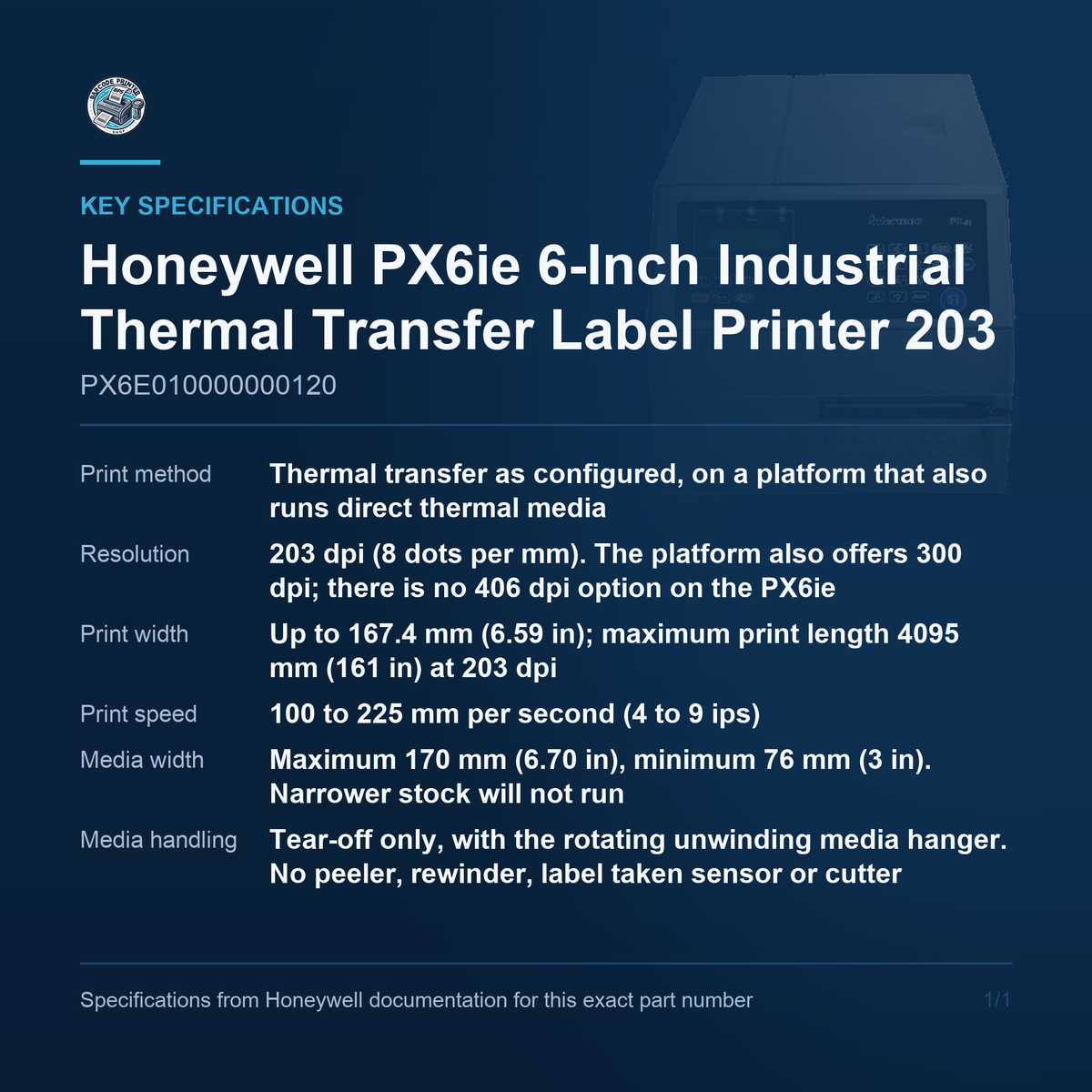
- Print method: Thermal transfer as configured, on a platform that also runs direct thermal media
- Resolution: 203 dpi (8 dots per mm). The platform also offers 300 dpi; there is no 406 dpi option on the PX6ie
- Print width: Up to 167.4 mm (6.59 in); maximum print length 4095 mm (161 in) at 203 dpi
- Print speed: 100 to 225 mm per second (4 to 9 ips)
- Media width: Maximum 170 mm (6.70 in), minimum 76 mm (3 in). Narrower stock will not run
- Media handling: Tear-off only, with the rotating unwinding media hanger. No peeler, rewinder, label taken sensor or cutter
- Media: Labels and tags, roll-fed or fanfold; roll to 213 mm (8.38 in) outside diameter; core 38 to 76 mm (1.5 to 3 in); thickness 2.4 to 10.0 mil; sensing by gap, notch, black mark or continuous
- Ribbon: Wax, mid-range and resin; roll to 80 mm (3.15 in) outside diameter, approximately 450 m; core inside diameter 25.4 mm (1 in). Ink-side orientation is not published
- Interfaces: Ethernet 10/100, USB 2.0 and RS-232 to 115.2 KB/s. No Wi-Fi, no parallel port and no RFID encoder on this configuration
- Memory and display: 128 MB Flash, 256 MB DDR2 SDRAM, optional multi-GB USB memory device; 2.3 in colour LCD with an interactive numeric keypad; real time clock fitted
- Power: Internal supply, 90 to 265 V AC at 45 to 65 Hz; 5 W standby, 125 W continuous average, 400 W peak
- Dimensions and weight: 482 x 238 x 335 mm (19.0 x 9.4 x 13.2 in), 14.13 kg (31.12 lb)
Configuration decoded
The PXie configuration code reassembles character for character against Honeywell's own configuration map, which makes this decode far stronger than the reconstructed one on the PC43 range. PX6E010000000120 reads as: 6-inch PXie, universal firmware, connectivity 1 for Ethernet with USB and serial, no I/O options in either field, 128 MB Flash with 256 MB DDR2, the rotating unwinding media hanger, media option 0 for none, meaning tear-off, a real time clock, and a 203 dpi printhead. Honeywell's own channel description names the same attributes independently, which is the cross-check that matters.
This is a PXie
This is a PXie, not a PX4i or a PX6i, and the distinction runs the opposite way to what the model name suggests to most people. The PXie range is the successor generation to the older Intermec PX4i and PX6i, not a value tier below them: Honeywell's own user guide is titled the PX4ie and PX6ie High Performance Printer User Guide, and the platform carries 128 MB of Flash with 256 MB of DDR2 SDRAM, roughly 450 m of ribbon capacity, an internal power supply and a 2.3 in colour LCD with a numeric keypad. The older PX4i and PX6i equivalents carry part numbers beginning PX4C and PX6C. Anything positioning a PX4E or PX6E part number as entry level has confused the two ranges.
Tear-off only
The media option on this part number is 0, which means none, and that single character removes four things a buyer might assume are present. There is no peeler or self-strip mechanism, so labels arrive on their liner. There is no rewinder, so nothing takes up the spent liner. There is no label taken sensor, so the printer cannot pace itself to an operator. And there is no cutter. It is a tear-off machine with the standard rotating unwinding media hanger. The 4-inch PX4E010000005120 we also list carries media option 5 and has the rewinder, enhanced self-strip and label taken sensor, and nothing in either model name shows that difference.
Minimum media width
The specification most likely to cause a wrong order on this printer is the media width floor. The PX6ie takes stock from 76 mm to 170 mm wide, and that 76 mm or 3 in minimum is a mechanical limit rather than a recommendation: a customer running 2-inch labels cannot use this machine at all, where the 4-inch PX4ie handles media down to 25.4 mm. Two further gaps sit alongside it on the same platform. The PX6ie has no 406 dpi option, which the PX4ie does, and it tops out at 9 ips against the PX4ie's 12. None of the three is size scaling; they are separate capability differences that happen to arrive together on the wider machine.
Interfaces fitted
Ethernet 10/100, USB 2.0 and RS-232 at up to 115.2 KB/s are fitted, with a full network stack behind them: TCP/IP, LPR/LPD, FTP, BOOTP, DHCP, HTTP, SNMPv3, SMTP, NTP and both IPv4 and IPv6. There is NO Wi-Fi on this part number. The connectivity field reads 1, which is Ethernet with USB and serial; a Wi-Fi build would read 2 or 3, and this one does not. That matters because this listing has carried wireless tags on our own store that the hardware does not support, and a buyer filtering for a wireless printer would have been sent the wrong machine. There is no parallel port and no RFID encoder either: both I/O option fields read none.
Printer languages
Every PXie ships the full command language set, because the firmware field has only one code: Fingerprint, Direct Protocol, IPL, ZSim2 as a ZPL-II emulation and DPL as a Datamax emulation. ZSim2 is the one that decides most replacement purchases, and it is included rather than being an extra-cost option, so an existing ZPL label format prints on this machine without being rewritten. There is one important gap: the PXie range does NOT carry ESim, the EPL emulation. A site replacing an older Zebra that still speaks EPL can drop in a Honeywell PC43 and cannot drop in a PXie, and that is worth checking against the label formats in use before the order rather than after. Configuration is by the PrintSet web interface, with an InterDriver Windows driver and CUPS for Linux.
Not published by Honeywell
Four things are missing from this listing because Honeywell does not publish them for the PXie range, and they are stated as absences rather than filled in from a sibling product. Honeywell prints no warranty term, no package-contents list, no MTBF or printhead-life figure and no processor specification on the PXie data sheet, and two independent passes confirmed each of them. In particular the warranty term published for the Honeywell PC43 desktop range belongs to that data sheet and is not carried across here: they are different product lines with different service programmes. What Honeywell does state is that communication cables are sold separately, so no USB, Ethernet or serial lead is in the carton. Ask us to confirm the current warranty and carton contents with Honeywell before the order.
Discontinued status
Honeywell has placed the PX6ie at end of life and names PX65A00000000200 as the successor to this exact configuration in its own channel text. Two independent distributors corroborate both the status and the successor part number. What does not exist is a date: Honeywell's product pages for the PX6ie have been withdrawn and return nothing, and the model does not appear on Honeywell's published discontinued-products list, so there is no discontinuation date and no service-end date to quote. That is a real difference from Honeywell's PC43 desktop range, which does publish both. Buy this printer to match an existing fleet, to replace a failed unit, or to keep a validated line running without requalifying label formats, and confirm service availability with us at the time of order.
Barcode Printer Shop supplies Honeywell printers to US businesses configuration by configuration rather than model by model, so the part number on the invoice is the one that fits the line. Contact us to learn more or secure this solution for your business today.